What Is an AI Agent Kill Switch? How to Keep AI Agents in Check
What an AI agent kill switch is, why CrowdStrike, IBM and Genpact are building agent controls, and the four layers ops teams need before go-live.
An AI agent kill switch lets an authorised person instantly stop a running AI agent, block it from restarting and cut its access to systems. It is the last line of defence, not the whole plan: safe agents also need least-privilege access, human approval for high-impact actions, full audit logs and autonomy that is earned step by step.
On this page
- Key takeaways
- What is an AI agent kill switch?
- Why is everyone talking about agent kill switches this month?
- Is a kill switch enough to govern AI agents?
- How do you decide which agent actions need human approval?
- What is earned autonomy, and how do agents graduate to it?
- What should an AI agent kill-switch runbook include?
- Where does AI infrastructure fit into agent governance?
- What should you do this week?
- Frequently asked questions
Key takeaways
- An AI agent kill switch lets an authorised person stop an agent, block relaunch and cut its access in one action.
- A kill switch is the last of four control layers: least privilege, approval gates, observability and audit, then the stop button.
- Gate actions by impact and reversibility: anything costly or hard to undo needs human sign-off, at least at first.
- Use earned autonomy: agents move from shadow mode to acting alone only on evidence, and drop a rung after any incident.
- Governance needs infrastructure that enforces it: per-agent identity, a gateway, scoped short-lived credentials and durable logs.
On November 3, CrowdStrike shipped something with a name straight out of a heist film: an AI Kill Switch. A week later, IBM and Microsoft launched a platform built to "govern AI agents with controls, observability and AI-compliance support." Then Genpact unveiled Onyx, where agents start by proposing actions for a human to approve.
Three big launches, one shared message. The industry has stopped asking "can agents do the work?" and started asking "what happens when one does the wrong work?"
If you run operations, that second question is now yours. So let’s answer it properly.
What is an AI agent kill switch?#
An AI agent kill switch is a control that lets an authorised person stop a running AI agent immediately, prevent it from restarting, and cut its access to systems and data. Think of the big red emergency-stop button on a factory machine. Nobody plans to press it. Everybody wants to know exactly where it is.
CrowdStrike’s announcement describes four moves: terminate the running agent, block it from launching again on the targeted hosts, cut off its enterprise network access, and do all of it with a human in control and every action recorded in an audit trail. CrowdStrike says termination works first at the AI gateway, with endpoint enforcement coming "soon." Its CEO, George Kurtz, summed up the pitch neatly: "When you deploy agents with a kill switch, you stay in control."
That is a useful product. It is also only the final layer of something bigger.
Why is everyone talking about agent kill switches this month?#
Agents have moved from answering questions to taking actions, and actions have consequences. A chatbot that gets something wrong produces a bad paragraph. An agent that gets something wrong can pay the wrong supplier, email the wrong customer, or close the wrong ticket, at machine speed.
The November launches all point at the same gap:
- CrowdStrike (Nov 3): the AI Kill Switch in Falcon Guardian, positioned as a way to stop rogue agents "with a human in control."
- IBM and Microsoft (Nov 10): Imagine Enterprise, aimed at regulated industries, with "enterprise security, identity, AI governance and control built into the experience." We unpacked what that launch means for buyers in pre-built vs. custom AI agents.
- Genpact (Nov 12 to 16): Onyx, whose CEO Balkrishan Kalra put the philosophy in six words: "Agents run the work. Our experts own the outcome."
Regulators got there first. Article 14 of the EU AI Act requires high-risk AI systems to let human overseers "intervene in the operation of the high-risk AI system or interrupt the system through a ’stop’ button or a similar procedure." According to the implementation timeline, those high-risk obligations apply from 2 December 2027 for most use cases. That sounds far away. In procurement years, it is next Tuesday.
Is a kill switch enough to govern AI agents?#
No. A kill switch is a seatbelt, and you still need brakes, mirrors and a driving test. If the only safety you have is the ability to stop an agent after it misbehaves, you have built a very expensive smoke alarm.
The OWASP Top 10 for LLM Applications has a name for the root problem: excessive agency. OWASP traces it to three causes: excessive functionality, excessive permissions and excessive autonomy. Notice that none of those is fixed by a stop button. They are fixed by design, before launch.
When we build agents for operations teams at Incube, we think about control as four layers, each answering a different question:
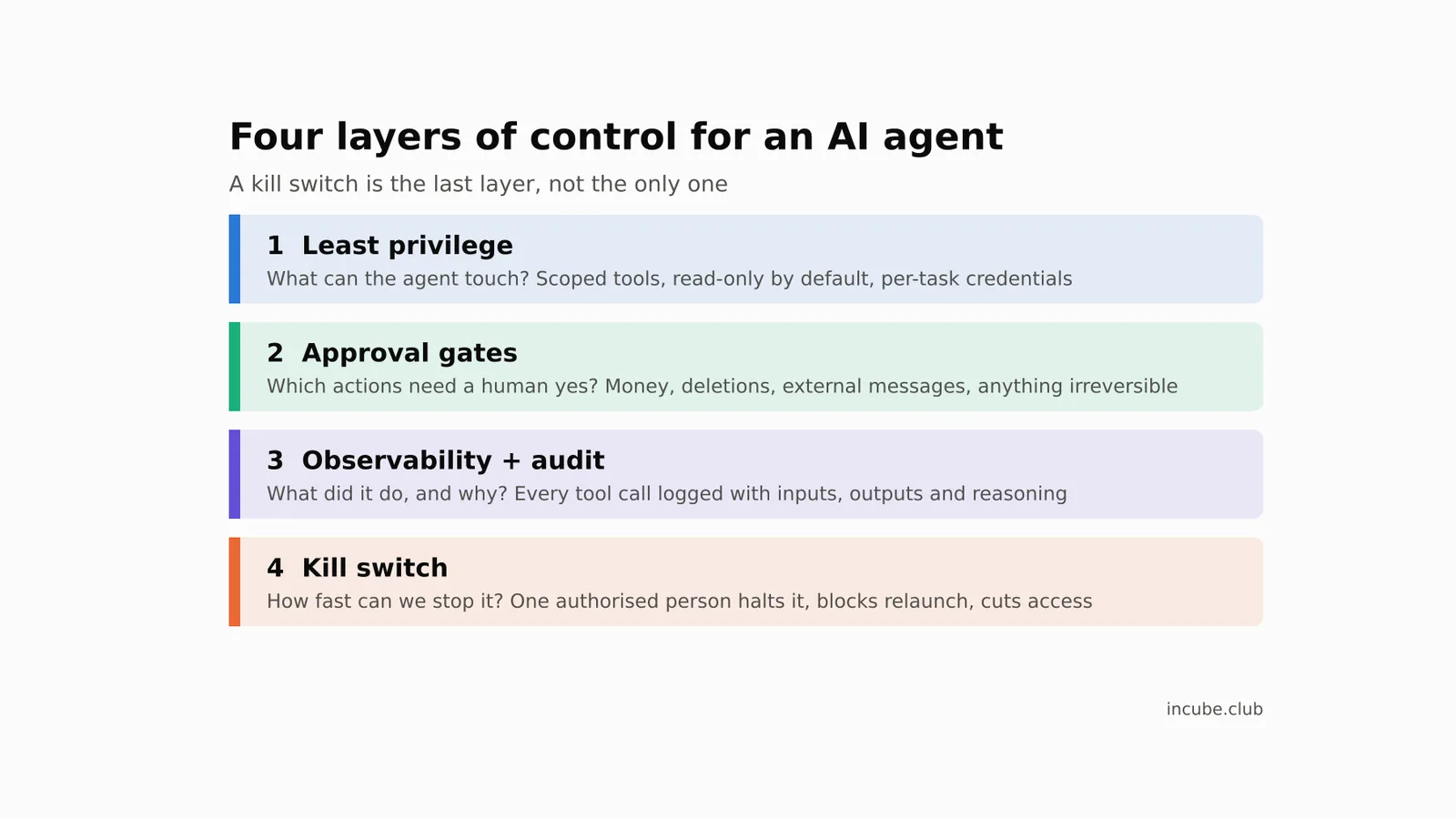
| Layer | The question it answers | What it looks like in practice |
|---|---|---|
| 1. Least privilege | What can the agent touch? | Only the tools the task needs, read-only by default, credentials scoped per task |
| 2. Approval gates | Which actions need a human yes? | Payments, deletions, external emails and anything irreversible wait for sign-off |
| 3. Observability and audit | What did it do, and why? | Every tool call logged with inputs, outputs and the reason behind the decision |
| 4. Kill switch | How fast can we stop it? | One named person can halt it, block relaunch and revoke access in one action |
Layer 1 shrinks the blast radius. Layer 2 catches the expensive mistakes before they happen. Layer 3 lets you find the quiet mistakes and learn from them. Layer 4 is for the day the first three are not enough.
OWASP’s own mitigation list maps neatly onto this. It recommends human-in-the-loop control "to require a human to approve high-impact actions before they are taken," and "complete mediation," which means enforcing permissions in the downstream system rather than trusting the model to police itself. That second point deserves a tattoo. Your agent should not be the one deciding whether your agent is allowed to do something.
How do you decide which agent actions need human approval?#
Sort every action the agent can take by two things: how much damage a mistake could do, and how easily you can undo it. Then gate anything that is high-damage or hard to undo.
Here is the simple triage we use when scoping an agent:
- List every action, not every task. "Process invoices" is a task. "Read PDF," "match to purchase order," "flag mismatch" and "schedule payment" are actions. Gates live at the action level.
- Score reversibility. Drafting a reply is reversible. Sending it is not. Tagging a ticket is reversible. Refunding a customer mostly is not.
- Score impact. Ask what one wrong action costs in money, customer trust or compliance exposure.
- Gate the top-right corner. High impact or low reversibility means a human approves, at least at first.
- Set hard limits on everything else. Value caps, rate limits, allowed recipients and working hours turn "autonomous" into "autonomous inside a fence."
For a concrete example, an invoice processing agent can read, extract and match all day without asking anyone. Scheduling a payment above a threshold, or to a new supplier bank account, is a different animal. That is where a human signs off, every time.
What is earned autonomy, and how do agents graduate to it?#
Earned autonomy is the practice of giving an AI agent more independence only after it has proven reliable at its current level. Genpact’s Onyx announcement describes exactly this: agents "start by proposing actions for a human expert to approve and take on more of the decision as they prove themselves."
It is how you would onboard a new hire. Nobody gives the intern the company card on day one. You watch their work, then you let them handle the routine stuff, then you check in less often.
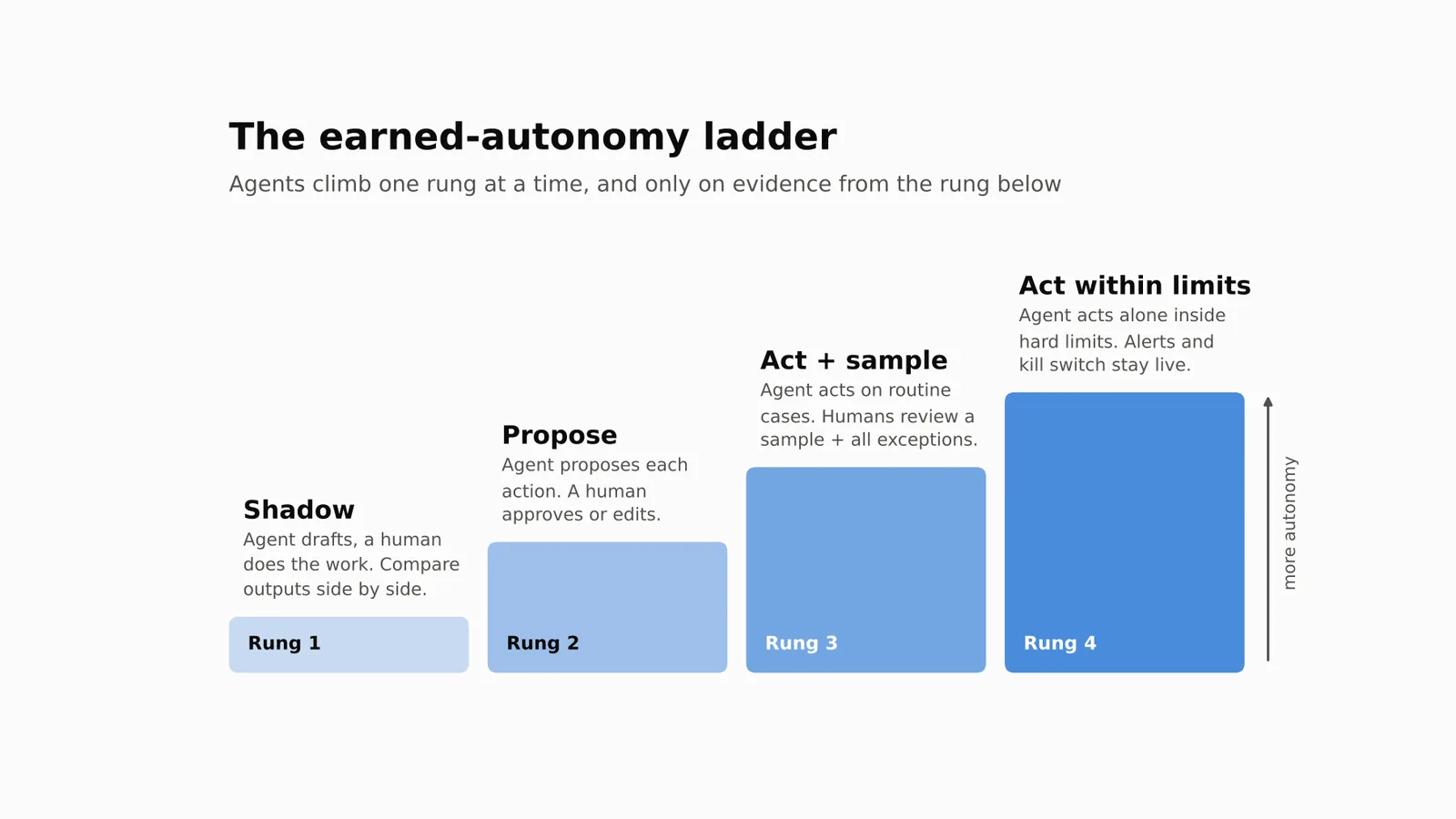
We usually run four rungs:
| Rung | What the agent does | What humans do | Evidence needed to climb |
|---|---|---|---|
| 1. Shadow | Drafts outputs in parallel | Do the real work, compare | Drafts match human decisions on real cases |
| 2. Propose | Proposes each action | Approve, edit or reject | Low edit rate, no serious errors |
| 3. Act and sample | Acts on routine cases | Review a sample plus every exception | Sampled errors stay inside the agreed tolerance |
| 4. Act within limits | Acts alone inside hard caps | Watch alerts, own the kill switch | Ongoing monitoring, regular re-checks |
Two rules make this work. First, climbing is a decision someone signs, not something that just drifts. Second, any incident drops the agent at least one rung. Trust is earned in steps and lost in one.
This is also why we tend to start teams with narrow, well-bounded agents. An inbox triage agent climbs the ladder quickly because its actions are cheap to reverse. A support resolution agent that issues refunds climbs more carefully. If you are still choosing where to start, our 5-step task audit helps you pick a first agent that can earn its stripes fast.
What should an AI agent kill-switch runbook include?#
A kill-switch runbook should say who can stop the agent, how they do it, what gets contained, how you investigate, and how you restart safely. Write it before go-live. Working it out mid-incident, with a CFO on the phone, is a poor learning environment.
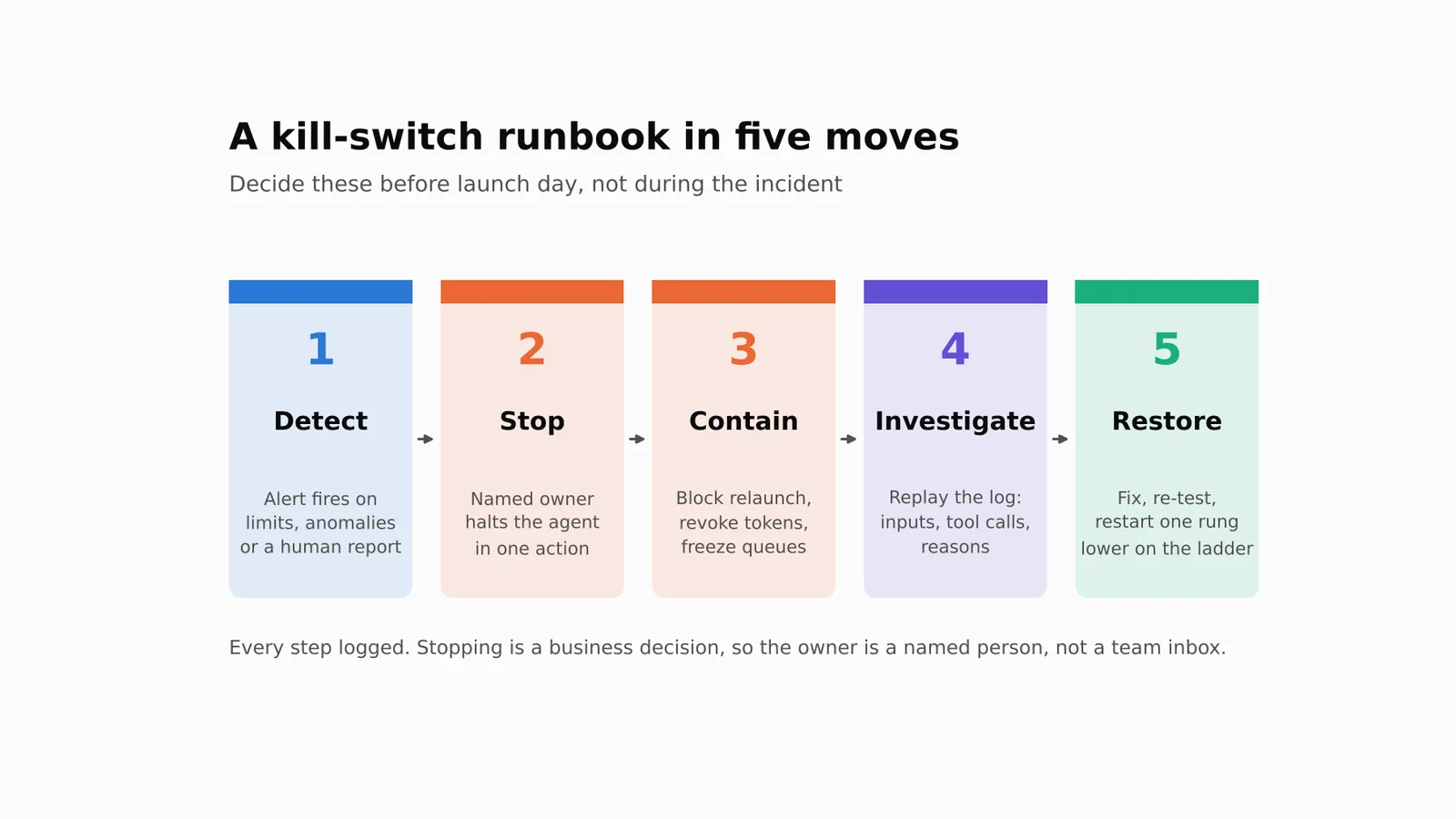
- Detect. Define the triggers: hard-limit breaches, unusual volumes, a spike in exceptions, or simply a human saying "that looks wrong." Every trigger should page a person, not a dashboard nobody reads.
- Stop. Name the owner. A specific person, with a deputy, who can halt the agent in one action. CrowdStrike’s design makes the same choice: an authorised administrator triggers the action.
- Contain. Block relaunch, revoke the agent’s tokens and API keys, and freeze any queued actions. Stopping the process while its credentials still work is like locking the front door and leaving the garage open.
- Investigate. Replay the audit log: what came in, what the agent decided, which tools it called, and why. If you cannot answer "why," layer 3 needs work.
- Restore. Fix the cause, re-test on recorded cases, and restart one rung lower on the autonomy ladder.
A good test: can someone on your team who did not build the agent stop it in under five minutes, using only the runbook? If the answer is "probably," the answer is no.
Where does AI infrastructure fit into agent governance?#
Governance only works if your infrastructure can enforce it. A policy that says "the agent can only read invoices" means nothing if the agent runs on an API key with admin rights.
This is the unglamorous part, and in our experience it is where most of the real work lives. Before an agent goes live, we check:
- Identity. Does each agent have its own identity, separate from any human account, so its actions are attributable?
- Gateway. Do model calls and tool calls pass through one controlled point where you can log, filter and block them? CrowdStrike’s kill switch acts at exactly this gateway layer first.
- Secrets. Are credentials short-lived and scoped, so revoking them actually stops the agent?
- Data boundaries. Is it clear which data the agent can send to which model, and where that model runs?
- Logs you can keep. Are audit records stored somewhere tamper-resistant, for as long as your regulators expect?
The NIST AI Risk Management Framework, released in January 2023, organises this work into four functions: Govern, Map, Measure and Manage. It is a sensible spine if your risk team wants a recognised structure. The four layers above slot straight into its Manage function.
This is also why we treat agent building and infrastructure setup as one job at Incube rather than two. An agent is only as controllable as the plumbing under it. If you want the bigger picture of how agents change workflows, our plain-English guide to agentic automation is a good companion read, and our services overview shows how the two pieces fit.
What should you do this week?#
Pick one agent, live or planned, and answer four questions with your team:
- What is the most expensive single action this agent can take?
- Who approves that action today, and is that written down?
- Could we reconstruct why the agent did something last Tuesday?
- Who stops it, and how many minutes would that take?
If any answer starts with "um," you have found your next project. The good news is that every gap on that list is fixable with design, not heroics. The kill switch is the headline this month, but the real story is everything you build so you rarely need to touch it.
Designing agents with these controls built in from day one is the kind of work we do, and if you want a second pair of eyes on your answers, we are happy to compare notes.
Frequently asked questions#
What is an AI agent kill switch?
An AI agent kill switch is a control that lets an authorised person immediately stop a running AI agent, prevent it from restarting and revoke its access to systems and data. CrowdStrike launched one in November 2026 as part of Falcon Guardian. It works best as the final safety layer, behind least-privilege access, approval gates and audit logging.
Does the EU AI Act require a stop button for AI systems?
For high-risk AI systems, yes in effect. Article 14 of the EU AI Act requires that human overseers can intervene in the system or interrupt it through a stop button or a similar procedure that brings it to a safe halt. Per the current implementation timeline, most high-risk obligations apply from 2 December 2027.
What is excessive agency in AI agents?
Excessive agency is OWASP’s term for an AI system being able to take damaging actions in response to unexpected, ambiguous or manipulated model outputs. OWASP lists three root causes: excessive functionality, excessive permissions and excessive autonomy. The fixes are design choices such as minimal tools, scoped permissions and human approval for high-impact actions.
What is earned autonomy for AI agents?
Earned autonomy means an AI agent gets more independence only after proving reliable at its current level. A common path runs from shadow mode, to proposing actions for human approval, to acting on routine cases with sampled review, to acting alone within hard limits. Any serious incident moves the agent back down a level.
Which AI agent actions should need human approval?
Actions that are high-impact or hard to reverse should need human approval, at least at first. Typical examples are payments, refunds, deletions, changes to supplier bank details and emails sent outside the company. Low-risk, reversible actions such as reading, tagging and drafting can usually run automatically inside hard limits.
How does Incube build control into AI agents?
Incube designs specialised agents with four control layers from day one: least-privilege tool access, approval gates on high-impact actions, full audit logging of every tool call and decision, and a tested kill-switch runbook. Agents start in shadow or propose mode and earn autonomy on evidence, on infrastructure that enforces the same rules.
Incube designs, builds and runs specialized AI agents for operations teams. We write about what we see working, and what to watch out for, when you put agents to work.
Put your first agent to work
Start with one workflow, clear guardrails and a measured pilot. We handle the audit, the build and the running.
Start a Pilot