What Is a Small Language Model? Why AI Agents Are Getting Smaller
What small language models are, how they run on phones and laptops, how they compare with LLMs, and why NVIDIA researchers say they suit AI agents.
A small language model (SLM) is a compact AI language model, usually from a few hundred million to around 10 billion parameters, that runs on everyday hardware like a phone, laptop or single server. SLMs trade some breadth for speed, lower cost, privacy and easy fine-tuning, which makes them a strong fit for the narrow, repetitive steps inside AI agents.
On this page
- Key takeaways
- What is a small language model?
- How small is "small" in 2026?
- How can a small model run on a phone?
- Small language models vs. large language models: what's the difference?
- Why do NVIDIA researchers say small models are the future of AI agents?
- What are small language models bad at?
- Should you run a small language model locally or in the cloud?
- What do small language models mean for agents that do real work?
- How should you start with small language models?
- The bottom line
- Frequently asked questions
Key takeaways
- A small language model (SLM) is a model compact enough to run on a phone, laptop or single server and answer quickly.
- Quantization shrinks memory dramatically: Google lists Gemma 4 E2B at about 11.4 GB in 16-bit and 2.9 GB in 4-bit.
- NVIDIA researchers estimate that roughly 40% to 70% of LLM calls in three open-source agents could be handled by specialised SLMs.
- SLMs are weaker at breadth, so the practical design is small specialists for routine steps with a large model and humans on call.
- Reliability comes from the system around the model: validation, confidence thresholds, monitoring and human review.
For three years the AI industry had one answer to every problem: make the model bigger. More parameters, more GPUs, more data centres the size of small towns. Then something quietly odd happened. Apple put a roughly 3-billion-parameter model directly onto iPhones, iPads and Macs. Google built its newest Gemma models to run inside a browser. And a group of NVIDIA researchers wrote a paper with a title that sounds like heresy in Silicon Valley: small models, they argued, are the future of AI agents.
So what is a small language model, why is everyone suddenly shrinking things, and what does it mean if you are trying to get real work done with AI? Let’s take it apart.
What is a small language model?#
A small language model (SLM) is a language model compact enough to run on everyday hardware, such as a laptop, a phone or a single modest server, while still answering quickly enough to be useful. That is close to the working definition in NVIDIA’s position paper Small Language Models are the Future of Agentic AI, which describes an SLM as a model that "can fit onto a common consumer electronic device" and respond with latency low enough to serve one user’s agent requests.
Notice what that definition does not include: a magic parameter count. There is no official cutoff. In practice, people usually mean models from a few hundred million parameters up to somewhere around 10 billion. The line is blurry on purpose, because hardware keeps moving it. Yesterday’s "too big for a laptop" is tomorrow’s "runs fine on the train".
A useful mental model: a large language model (LLM) is a brilliant generalist consultant who has read the entire internet. A small language model is the sharp specialist who has read the three manuals that matter for your job, and who turns up in thirty seconds instead of next Tuesday.
How small is "small" in 2026?#
Small in 2026 means roughly 1 to 4 billion parameters for phones and browsers, and up to around 10 to 14 billion for a decent laptop or a single GPU. Here are some well-documented examples from the people who built them:
| Model | Size | Built for | What the maker says |
|---|---|---|---|
| Apple on-device foundation model | ~3B parameters | iPhone, iPad, Mac | Optimised for Apple silicon; available to developers through the Foundation Models framework (Apple) |
| Gemma 4 E2B and E4B | 2B and 4B "effective" parameters | Phones, edge devices, browsers | 128K context window, built-in function calling (Google) |
| Llama 3.2 1B and 3B | 1B and 3B | Edge and mobile | 128K context, multilingual text, tool calling (Meta) |
| SmolLM3 | 3B | Anywhere, fully open | Trained on 11 trillion tokens, with the full training recipe published (Hugging Face) |
| Gemini Nano | On-device | Android phones | Runs inside Android’s AICore system service, no network needed (Android Developers) |
| Phi-4 | 14B | Single GPU, reasoning | Trained with a heavy focus on data quality and synthetic data (Microsoft Research) |
Phi-4 sits at the chunky end of "small", and some people would not call it an SLM at all. It is on the list because it makes a point worth remembering: careful training data can let a mid-sized model punch far above its weight class.
How can a small model run on a phone?#
A small model runs on a phone through three tricks working together: fewer parameters, lower-precision numbers, and clever architecture. The second trick, quantization, does a surprising amount of the heavy lifting.
Quantization means storing each of the model’s numbers with fewer bits. Instead of 16 bits per weight, you use 8 or even 4. You lose a little precision, a bit like saving a photo as a well-tuned JPEG instead of a RAW file, and you save an enormous amount of memory. Google’s own memory table for Gemma 4 shows how dramatic this gets.
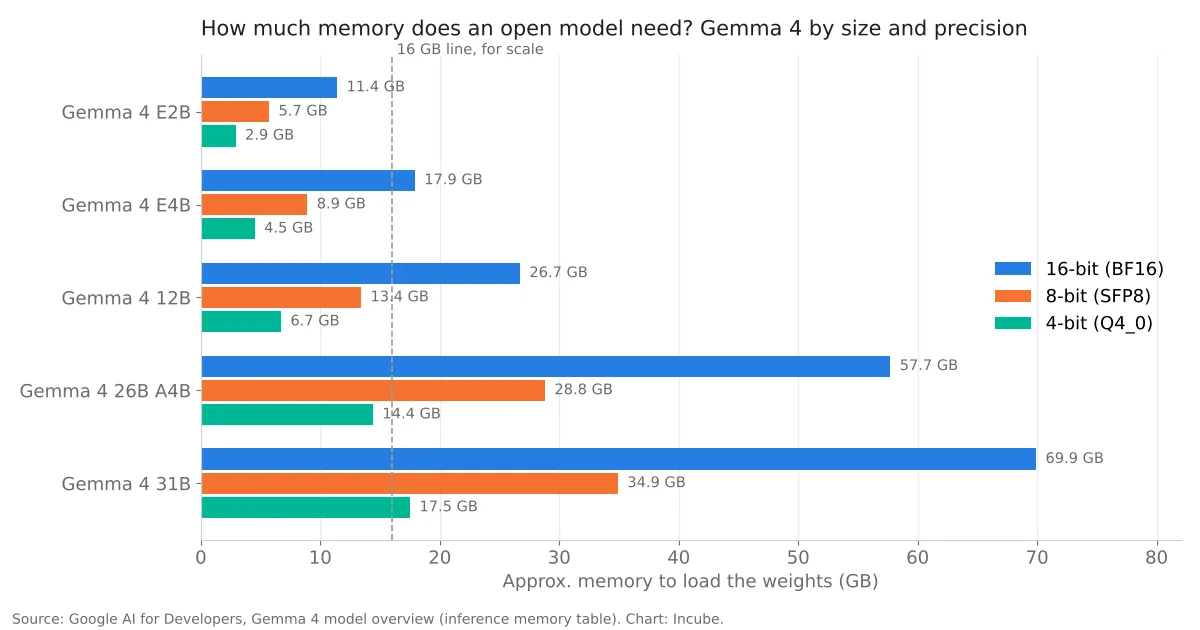
According to Google’s Gemma 4 overview, the E2B model needs about 11.4 GB at 16-bit precision, 2.9 GB at 4-bit, and roughly 1.1 GB in its mobile build. That is the difference between "needs a workstation" and "fits next to your holiday photos". Google also offers quantization-aware training, where the model learns to cope with lower precision during training rather than being squeezed afterwards.
The architecture tricks are just as clever. Apple says it split its on-device model into two blocks and let the second block reuse the first block’s key-value cache, which cut that cache’s memory use by 37.5% and sped up the time to the first word (Apple Machine Learning Research). Gemma 4’s small models use per-layer embeddings, which is where that "E" for "effective" parameters comes from. Engineers, it turns out, are very good at packing suitcases.
Small language models vs. large language models: what’s the difference?#
The difference between small and large language models is a trade between breadth and efficiency. LLMs know more about more things and handle open-ended reasoning better. SLMs are cheaper, faster, more private and much easier to fine-tune for one narrow job.
| Small language model | Large language model | |
|---|---|---|
| Where it runs | Phone, laptop, one GPU, your own server | Large cloud GPU clusters |
| Speed | Fast first response, no network round trip when local | Depends on network and provider load |
| Cost per call | Low, often just your own electricity | Higher, usually metered per token |
| Privacy | Data can stay on the device | Data usually leaves your environment |
| Breadth of knowledge | Narrower | Very broad |
| Fine-tuning | Affordable, quick to iterate | Expensive, often not offered |
| Best at | Repetitive, well-defined tasks | Open-ended reasoning, rare edge cases |
On cost, the NVIDIA paper cites prior work estimating that serving a 7-billion-parameter SLM is 10 to 30 times cheaper in latency, energy and compute than a 70 to 175 billion parameter LLM. Treat that as a direction of travel rather than a quote for your invoice, since real costs depend on hardware and traffic. But the direction is very clear.
Why do NVIDIA researchers say small models are the future of AI agents?#
NVIDIA’s researchers argue that most of what an AI agent does is narrow and repetitive, so a fine-tuned small model is good enough, better suited and far cheaper for most agent calls. Their paper makes three claims: SLMs are powerful enough for many agent tasks, operationally a better fit, and more economical.
The key insight is about what agents actually do all day. Chat assistants face an infinite variety of questions. Agents, by contrast, mostly repeat a handful of moves: read this, pick a tool, fill in that format, summarise the result. You do not need a model that can write sonnets in Old Norse to decide whether an email is an invoice.
To test the idea, the authors looked at three popular open-source agents and estimated how many of their LLM calls a specialised small model could reliably handle. These are the authors’ own estimates, not measured benchmark results, but they are revealing.
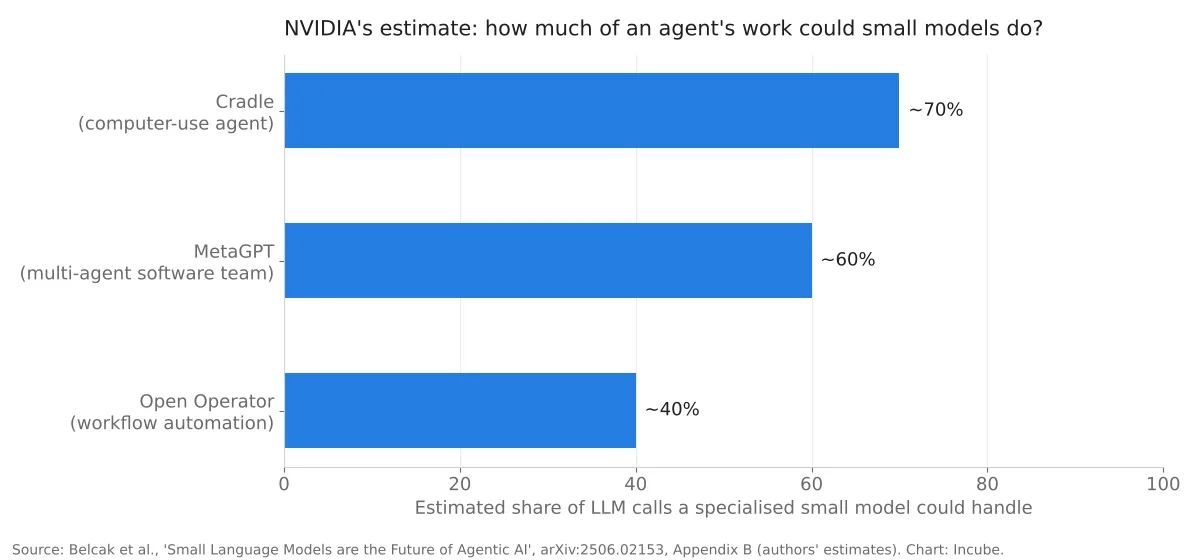
They estimate about 40% for Open Operator, a workflow automation agent, 60% for MetaGPT, a multi-agent "software company", and 70% for Cradle, a computer-use agent. In other words, a large share of the expensive generalist’s working day is spent on jobs a well-trained specialist could do.
The paper even sketches a recipe for converting an agent from LLM-only to mostly SLM:
- Log the agent’s real calls securely, including prompts, outputs and tool calls.
- Clean the data and strip personal or sensitive information. The authors suggest 10,000 to 100,000 examples is often enough to fine-tune a small model.
- Cluster the requests to find recurring tasks, like intent detection or data extraction.
- Pick a candidate SLM for each task, based on capability, licence and footprint.
- Fine-tune it, often cheaply with techniques like LoRA or QLoRA.
- Keep iterating, retraining the small models and the router as new data arrives.
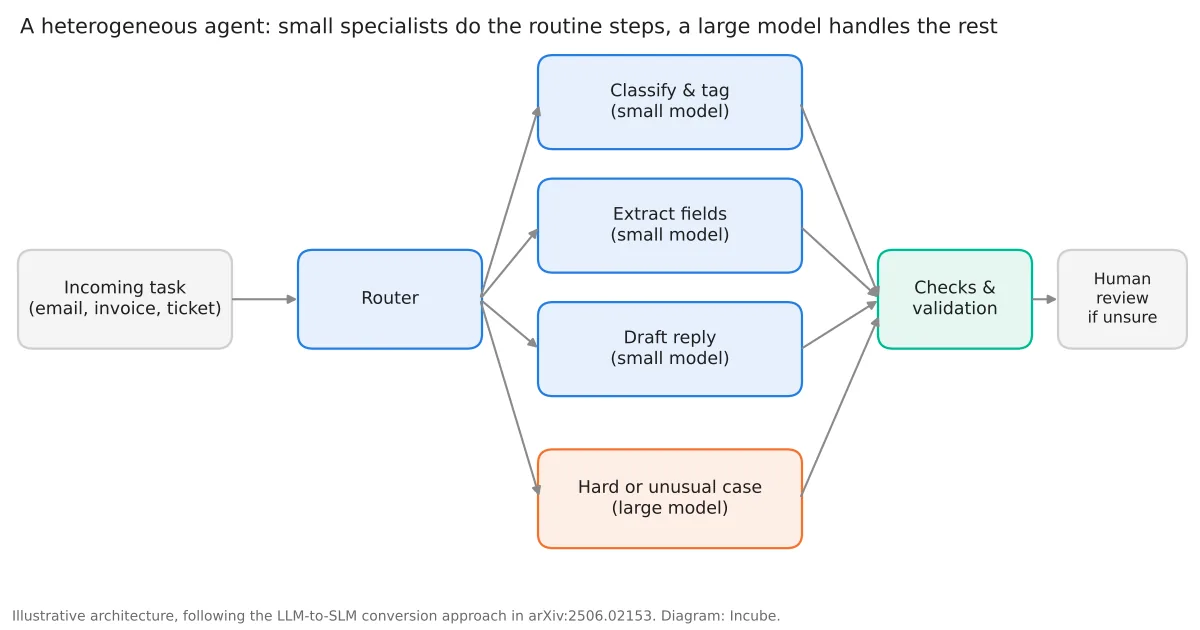
The end state is what the authors call a heterogeneous system: small specialists for the routine steps, with a large model kept on call for the genuinely hard stuff.
What are small language models bad at?#
Small language models are bad at breadth. Ask one an obscure trivia question, a multi-step legal argument or a task it has never seen, and it will struggle more, and sometimes bluff more confidently, than a big model would. Smaller memory means less world knowledge stored inside the weights.
They also need more care. A fine-tuned SLM is only as good as the examples it learned from, so if your data is messy, your specialist will be messy too. And because each specialist is narrow, you need something sensible deciding which model gets which job. Get the routing wrong and you have sent your invoice to the poet.
This is why the honest answer is rarely "small instead of large". It is "small where it fits, large where it is needed, and checks everywhere".
Should you run a small language model locally or in the cloud?#
You can run a small language model either way, and the right choice depends on your data and your volume. Running locally, on a laptop, phone or your own server, keeps sensitive data inside your walls, works offline and costs nothing per call once the hardware is paid for. That makes it attractive for regulated teams and for anything touching customer records, contracts or health information.
Running a small model in the cloud is simpler to scale and maintain. You still get most of the speed and cost benefits, because a small model needs far less compute per request than a giant one, but someone else worries about the servers, updates and uptime.
Many teams end up with a mix. The private, high-volume steps run close to the data, while occasional heavy reasoning goes to a hosted large model. The trick is to make that decision step by step, not once for the whole company, and to write down why each step lives where it does. Future you, staring at an audit request, will be grateful.
What do small language models mean for agents that do real work?#
For agents that do real work, small language models make specialisation the sensible default. When we build agents for operations teams at Incube, the first thing we map is not which model to use. It is which steps of the job are boring, repetitive and well defined, because those are exactly the steps where a narrow, tested component beats a clever generalist.
Take an invoice processing agent. Reading a vendor name, matching a PO number and checking totals is a tight, repeatable job. A specialised model that has seen thousands of your real invoices tends to be faster, cheaper and more predictable at it than a giant model improvising each time. The same logic applies to an inbox triage agent sorting thousands of emails into a dozen buckets.
What makes these agents trustworthy is not model size. It is everything around the model: validation rules that catch impossible totals, confidence thresholds that send uncertain cases to a person, monitoring that spots drift, and a clear way for humans to stay in control. That is the part we spend most of our time on, and it is why we think of agents as engineered systems rather than clever prompts. If you want the bigger picture, our guide on what context engineering is covers how to feed these models the right information, and our look at why AI agents fail everyday tasks shows what happens when nobody checks the work.
How should you start with small language models?#
You should start with the task, not the model. Here is a short, practical checklist:
- List the repetitive steps in one workflow, such as classify, extract, route or draft.
- Check the data rules. If data must stay on your devices or in your region, local SLMs move up the list.
- Try an open model locally. Gemma 4, Llama 3.2 and SmolLM3 can all run on ordinary hardware with tools like llama.cpp.
- Measure on your own examples, not leaderboards. A hundred real cases tell you more than any benchmark.
- Keep a big model as the fallback for the weird stuff, and a human for anything high-stakes.
- Add checks before you add autonomy. Validation and review queues come first.
If you are still choosing where to begin, our 5-step task audit for your first AI agent walks through it.
The bottom line#
The race to build ever-larger models is not over, and frontier LLMs will keep getting more capable. But the future of getting work done looks less like one giant brain and more like a well-run team of specialists, each small, fast and good at one thing, with a senior expert on call and a human signing off.
Here is a question to take to your team this week: which three steps in your busiest workflow are so repetitive that a well-trained specialist could do them every time, and how would you check its work? If you would rather have that specialist built, tested and monitored for you, designing your own specialised agents is exactly what Incube does.
Frequently asked questions#
What is a small language model?
A small language model (SLM) is a language model compact enough to run on consumer hardware such as a phone, laptop or single server, with low enough latency to be useful. There is no official size cutoff, but most people mean models from a few hundred million parameters up to around 10 billion. Examples include Apple’s roughly 3B on-device model, Gemma 4 E2B and E4B, Llama 3.2 1B and 3B, and SmolLM3.
What is the difference between an SLM and an LLM?
An LLM is a very large general-purpose model that knows a lot about many topics and usually runs on cloud GPU clusters. An SLM is much smaller, so it is faster, cheaper per call, easier to fine-tune and can keep data on your own device. The trade-off is breadth: SLMs know less and handle unfamiliar, open-ended tasks less well than large models.
Can small language models run on a phone?
Yes. Apple runs a roughly 3-billion-parameter model on its devices, and Android phones run Gemini Nano through the AICore system service. Quantization makes this possible by storing model weights in fewer bits. Google lists its Gemma 4 E2B model at about 1.1 GB in its mobile build, compared with about 11.4 GB at full 16-bit precision.
Why are small language models good for AI agents?
Most of what an AI agent does is narrow and repetitive, such as classifying a request, extracting fields or calling a tool. A fine-tuned small model can do these steps quickly and cheaply. NVIDIA researchers estimate that about 40% to 70% of LLM calls in three open-source agents could be handled by specialised SLMs, with a large model kept for harder cases.
How do you make an agent built on small models reliable?
Reliability comes from the system around the models. Route each step to the right specialist, validate outputs against business rules, send low-confidence cases to a person, and monitor for drift over time. This is how Incube builds specialised agents for operations teams: tested, checked and monitored components, with humans in control of the decisions that matter.
Incube designs, builds and runs specialized AI agents for operations teams. We write about what we see working, and what to watch out for, when you put agents to work.
Put your first agent to work
Start with one workflow, clear guardrails and a measured pilot. We handle the audit, the build and the running.
Start a Pilot