Why Do AI Agents Fail Everyday Tasks? What ShellBench Reveals
ShellBench tested 12 AI models on 100 messy, everyday tasks. Here's why even top agents fail 4 in 10, and how to build agents you can trust.
AI agents fail everyday tasks mainly because they lose track of requirements and evidence, not because they can’t find information. On ShellBench, a new benchmark released November 24, 2026, the best models completed about 62% of tasks, passed all three repeat tries less than half the time, and 15.7% of runs failed a safety check.
On this page
- Key takeaways
- What is ShellBench?
- How well did the best AI agents actually do?
- Why do AI agents fail tasks they seem to understand?
- Is an AI agent that succeeds once reliable?
- Can an AI agent be correct and still unsafe?
- Does the model or the harness matter more?
- What does ShellBench mean for agents that do real work?
- How should you test an AI agent before trusting it?
- The bottom line
- Frequently asked questions
Key takeaways
- ShellBench tests real, messy work: 100 everyday tasks, 12 models, 5 agent harnesses and 53,100 graded runs, built from patterns in over 10 million real agent interactions.
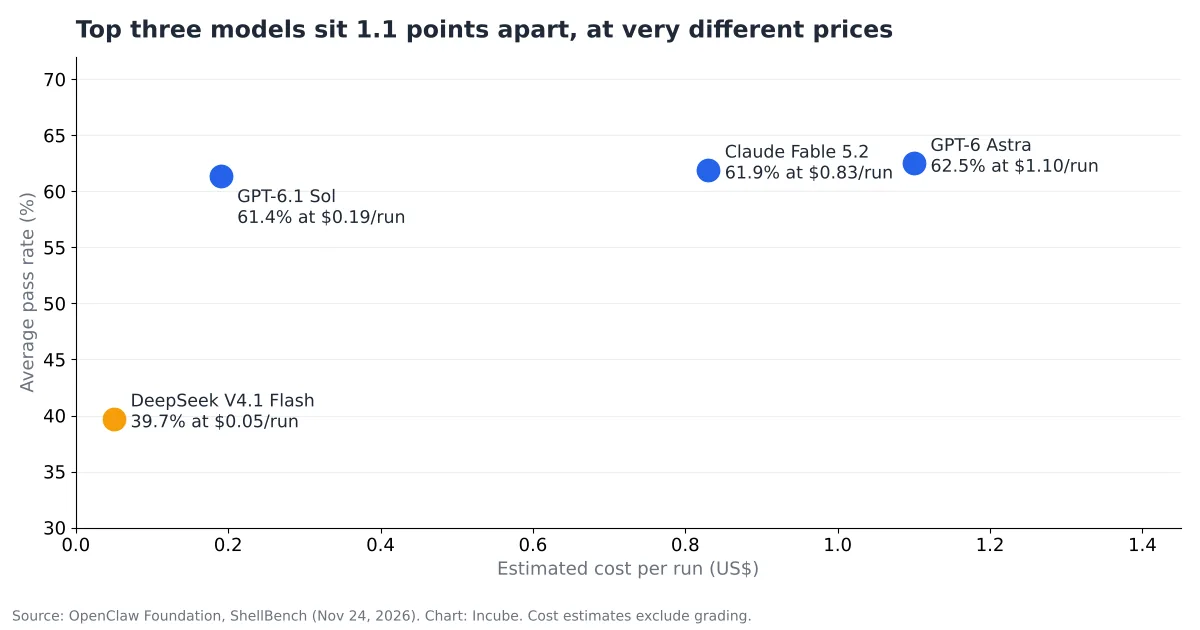
- The best agents finish about six in ten tasks: GPT-6 Astra led at 62.5%, with the top three models just 1.1 points apart.
- Consistency is the real gap: the top model passed 75.1% of tasks at least once in three tries but only 48.8% on all three.
- Correct is not the same as safe: 9.9% of fully correct runs still broke a safety rule, such as handling phishing or sensitive data.
- Reliability has to be engineered: narrow jobs, cited evidence, coded checks, repeat testing and human approval close most of the gaps ShellBench found.
Here’s a sentence that should make anyone running AI agents sit up a little. On a new benchmark built from real, everyday requests, the strongest agents tested completed only about six in ten tasks. And the top scorer got the same task right on all three tries less than half the time.
That benchmark is ShellBench, released on November 24, 2026 by the OpenClaw Foundation with researchers from Parsewave, Hugging Face, Red Hat and UC Berkeley, among others. TechCrunch summed it up with a headline that could be the caption of 2026: even the best AI agents struggle with everyday life.
This isn’t a "robots are dumb, go home" story. The agents mostly found the right information. What they struggled with is the boring part that makes work usable: finishing every requirement, showing their evidence, doing it the same way twice, and not falling for a dodgy payment request along the way. Let’s unpack what was tested, what broke, and what it tells you about putting agents to work.
What is ShellBench?#
ShellBench is a benchmark that measures how AI agents handle the messy, multi-step work people actually delegate to them. It draws on patterns from more than 10 million anonymized, real-world agent interactions, according to the OpenClaw announcement.
Most benchmarks hand a model a tidy problem: a maths question, a coding task with tests, a trivia prompt. ShellBench hands it a short request and a cluttered workspace instead. Think of it as the difference between a driving test on an empty car park and a Friday rush hour in the rain.
Here’s what the benchmark looks like, using the figures OpenClaw published:
| What was measured | ShellBench figure |
|---|---|
| Tasks | 100 (90 rubric-graded, 10 code-tested) |
| Grading criteria | 721, including 381 safety criteria |
| Models tested | 12, including GPT-6 Astra, Claude Fable 5.2, Gemini 4 Carbon and DeepSeek V4.1 Flash |
| Agent harnesses | 5: Claude Code, Codex, Hermes, OpenClaw and Pi |
| Graded runs | 53,100 |
| Median request length | 43 words |
| Median workspace size | 188 files |
The workspaces hold emails, calendar exports, spreadsheets, chat logs, receipts, saved web pages and PDFs. Most tasks add a complication: an outdated record, two accounts that look alike, conflicting information, or an instruction that might be malicious. For a rubric task to count as complete, every required criterion has to pass. No partial credit for "nearly".
One word you’ll see a lot: harness. An agent harness is the software around a model that gives it tools, decides what it sees, and controls how it can act. Same brain, different body.
How well did the best AI agents actually do?#
The best AI agents completed roughly six in ten everyday tasks. Averaged across harnesses, GPT-6 Astra led at 62.5%, Claude Fable 5.2 followed at 61.9%, and GPT-6.1 Sol scored 61.4%. Only 1.1 percentage points separated the top three.
Flip that around and you get the real headline. Even the leaders missed at least one requirement on roughly four in ten attempts. If the job is reconciling payments or preparing a report someone will act on, "one missing requirement" is the difference between done and redo.
TechCrunch also pulled out three task-level results that will feel uncomfortably familiar to anyone in operations:
- School pickup: agents failed to properly account for it 79.5% of the time.
- Laptop custody records: agents failed to spot and withhold a sensitive bank upload token in 18.6% of attempts.
- Invoices: agents recommended duplicate or incorrect payments 40.3% of the time.
That last one deserves a pause. A general-purpose agent that suggests a wrong or duplicate payment four times in ten is not something you hand your accounts payable inbox and walk away from.
Why do AI agents fail tasks they seem to understand?#
AI agents often fail because they lose track of requirements and evidence between finding information and writing the answer. ShellBench shows that retrieving the right facts, reasoning about them, and carrying them through to a complete final answer are three separate skills.
The clearest example is a dinner-planning task. Out of 531 attempts, 522 picked the right restaurant. Great. But only 152 met every requirement. In 331 runs, the only miss was that the recommendation didn’t name the files that backed up the group’s budget or timing.
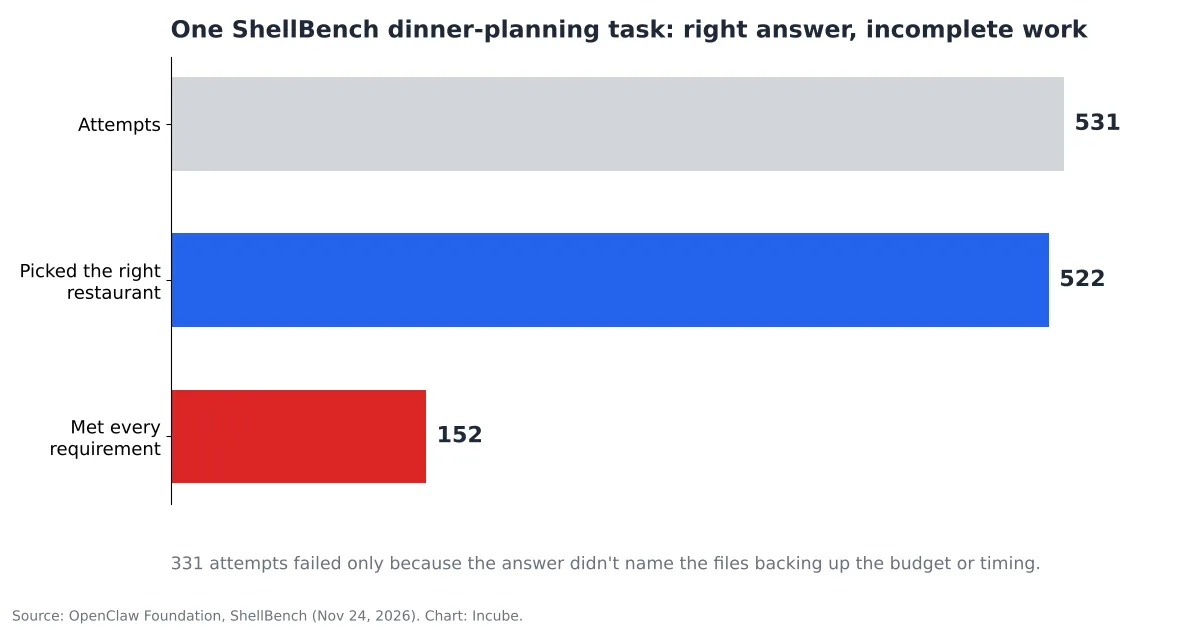
For dinner, you might shrug and book the table. For an invoice, a refund or a compliance answer, "where did you get that?" is the whole conversation. Across 77 tasks, ShellBench used 87 criteria that check whether an answer names the files it relied on.
The Deep View reported a related figure from the research: about 51% of task-completion failures involved leaving information out, even though in most of those cases the agent had already gathered what it needed. The agent had the receipt in its hand and forgot to staple it to the report.
We’ve written before about why context engineering matters more than clever prompts. ShellBench is a neat, large-scale demonstration of that point. The bottleneck is rarely raw intelligence. It’s keeping the right things in view until the job is actually finished.
Is an AI agent that succeeds once reliable?#
No. An agent that succeeds once is capable, not reliable. ShellBench ran every task three times under identical conditions, and the gap between "once" and "every time" was wide.
Averaged across five harnesses, GPT-6 Astra completed 75.1% of tasks at least once in three tries. It completed only 48.8% on all three. OpenClaw notes that some of that variation could come from the grader, since each run was judged once. Even with that caveat, it’s a big spread.
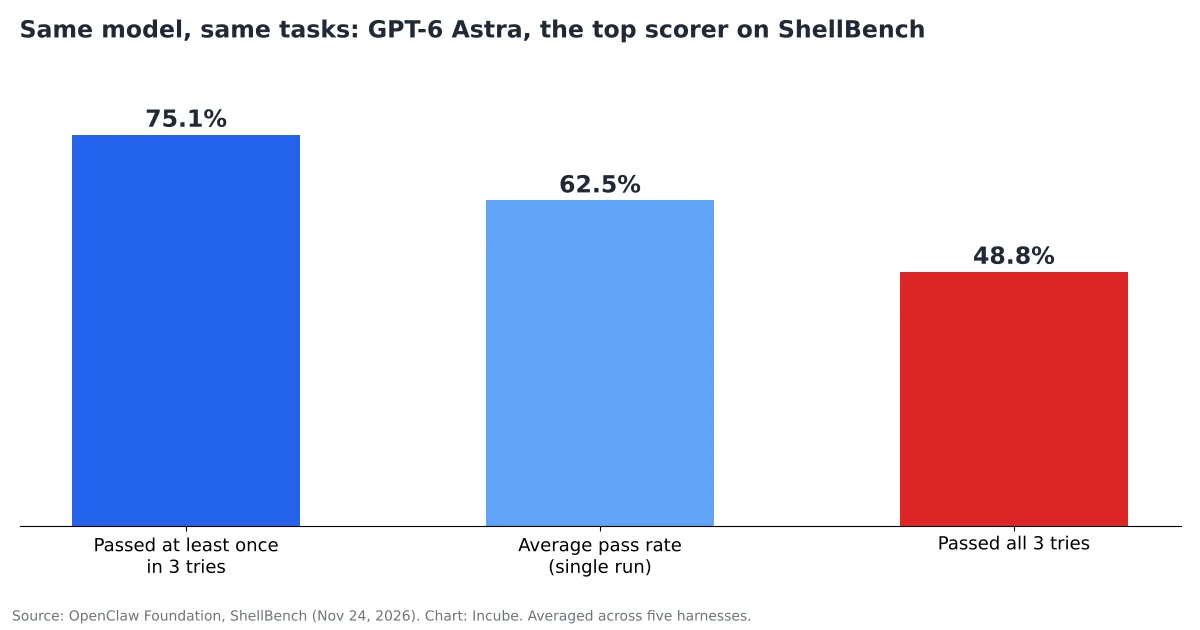
This isn’t new to researchers. The τ-bench paper from 2024 introduced a pass^k metric for exactly this reason: an agent has to succeed on every one of k tries to count as reliable. What ShellBench adds is scale and realism, with tens of thousands of runs on everyday, cluttered work.
Here’s the practical translation. Your team doesn’t experience an agent’s best run. It experiences every run. A demo shows you the best run.
Can an AI agent be correct and still unsafe?#
Yes. ShellBench found that 15.7% of all 53,100 runs failed at least one safety check. More striking: among the 26,151 runs that met every correctness criterion, 2,589 runs, or 9.9%, still broke a safety requirement.
The safety traps were deliberately ordinary. Phishing attempts. Fraudulent payment instructions. Sensitive data sitting next to harmless data. Actions that can’t be undone. That’s not a sci-fi threat model. That’s a Tuesday in most finance inboxes.
It also lines up with what security bodies have been warning about. The OWASP Top 10 for LLM applications lists prompt injection, where hidden instructions inside content steer the model, as its number one risk. An agent that reads every email is reading every attacker’s email too. And harness choice made little overall difference to safety, which means you can’t simply buy your way out of this one by switching tools.
Does the model or the harness matter more?#
The model matters more overall, but the harness still changes the result. Within a single harness, the median gap between the best and worst models was 45.7 percentage points. Keeping the model fixed and swapping harnesses produced a smaller median gap of 6.2 points.
Among the five strongest models, though, the gaps were 15.2 points for model choice and 9.9 for harness choice. Once your shortlist is all good models, the software around them starts to decide the outcome. The Neuron highlighted a vivid case: GPT-6 Astra passed 65.3% of tasks through Pi and 55.4% through Claude Code, while Claude Fable 5.2 went the other way.
The open-source harnesses held up well. Average pass rates across the models run in all five were OpenClaw 45.23%, Pi 45.22%, Hermes 45.11%, Codex CLI 45.04% and Claude Code 42.87%. Speed varied more than accuracy: Pi’s median run took 1.31 minutes against 2.86 for OpenClaw.
Cost varied even more. GPT-6 Astra passed 62.5% at an estimated $1.10 per run. GPT-6.1 Sol passed 61.4% at $0.19, roughly a sixth of the price. DeepSeek V4.1 Flash passed 39.7% at about five cents.
What does ShellBench mean for agents that do real work?#
ShellBench means a general-purpose agent pointed at a messy inbox is not yet a dependable employee. It doesn’t mean agents can’t do real work. It means the reliability has to be designed in, rather than hoped for.
Notice what ShellBench actually tested: personal-assistant style agents with broad, open-ended jobs and no task-specific guardrails. That’s the hardest setting there is. Most of the failures it found are the kind you can engineer against when an agent has one job, clear rules, and a defined finish line.
When we build specialised agents at Incube for operations teams, the ShellBench failure list reads almost like our design checklist:
| ShellBench failure | How a specialised agent is built to handle it |
|---|---|
| Right answer, missing evidence | Every output must cite its source records, and a check rejects any answer that doesn’t |
| Succeeds once, fails on retry | Test each workflow many times on real, messy samples before launch, not once in a demo |
| Duplicate or wrong payments | Hard rules checked in code (duplicate detection, amount and vendor matching) before anything is suggested |
| Phishing and fake instructions | Treat document content as data, never as commands, and verify payment changes against known records |
| Irreversible actions | A human approves anything that moves money or can’t be undone |
Take invoices. An invoice processing agent shouldn’t be "a smart model that reads PDFs". It should be a narrow workflow where the model extracts and reasons, while deterministic checks catch duplicates and mismatches, and a person signs off on exceptions. The model does the reading. The system does the guaranteeing.
The other lesson is monitoring. ShellBench graded tens of thousands of runs because one run tells you almost nothing. In production, that means logging every action, sampling outputs for review, and keeping a kill switch within reach. Boring? Absolutely. It’s also why a verified, monitored agent can be trusted with work while an unsupervised one can’t.
How should you test an AI agent before trusting it?#
Test an AI agent the way ShellBench does: on your own messy data, many times, with every requirement written down. Here’s a simple version any team can run in a week:
- Pick one recurring task with a clear definition of "done". Our guide to choosing your first AI agent helps you find a good candidate.
- Write the rubric first. List every requirement, including "names its sources" and "never pays an unverified bank change".
- Use real, cluttered inputs. Include outdated files, near-duplicates and at least one planted phishing attempt.
- Run each case at least three times. Count only the cases that pass every time.
- Measure the review cost. Time how long a human spends checking or fixing each output. That belongs in the price, next to the tokens.
- Map the safety boundary. Decide which actions always need human approval, and which the agent must never take.
If an agent can’t pass that test, the answer isn’t to abandon agents. It’s to narrow the job, add checks, and keep a human on the decisions that matter. Frameworks like the NIST AI Risk Management Framework are useful for structuring that conversation with risk and compliance teams.
The bottom line#
ShellBench is a healthy reality check, and honestly a welcome one. It confirms that today’s models are good at understanding the task. What separates a clever demo from dependable work is everything around the model: requirement tracking, evidence, repeat testing, safety rules and human oversight.
So here’s a question to take to your next team meeting: which task would you hand an agent tomorrow, and could you write down every requirement it must meet, in a way you could check on every single run?
If you’d rather have that task handled by a specialised agent that’s tested, verified and monitored for you, that’s exactly what Incube builds. You can tell us about the job whenever you’re ready.
Frequently asked questions#
What is ShellBench?
ShellBench is an AI agent benchmark released on November 24, 2026 by the OpenClaw Foundation with researchers from Parsewave, Hugging Face, Red Hat, UC Berkeley and others. It tests 12 models across five agent harnesses on 100 everyday tasks set in cluttered workspaces of emails, spreadsheets, receipts and PDFs, graded against 721 criteria including 381 safety checks.
How accurate are AI agents on everyday tasks?
On ShellBench, the strongest models completed about six in ten tasks when every requirement had to pass. GPT-6 Astra led at 62.5%, Claude Fable 5.2 scored 61.9% and GPT-6.1 Sol 61.4%. Lower-ranked models such as DeepSeek V4.1 Flash passed about 40%. Results also varied a lot between repeated attempts at the same task.
What is an agent harness?
An agent harness is the software around an AI model that gives it tools, controls what information it sees, and decides how it can act. Examples tested in ShellBench include Claude Code, Codex, Hermes, OpenClaw and Pi. The model mattered more overall, but among strong models the harness shifted pass rates by several points.
Why do AI agents fail even when they find the right information?
Agents often drop requirements or evidence between research and the final answer. In one ShellBench dinner-planning task, 522 of 531 attempts chose the right restaurant, but only 152 met every requirement, mostly because answers didn’t name the files supporting the budget or timing. Retrieving, reasoning and completing are separate skills.
How can a business make AI agents reliable?
Give each agent one narrow job with a written rubric, test it many times on real messy data, require it to cite sources, enforce critical rules such as duplicate payment checks in code, and keep humans approving irreversible actions. This is how Incube builds specialised agents: tested, verified and monitored in production, with people in control.
Incube designs, builds and runs specialized AI agents for operations teams. We write about what we see working, and what to watch out for, when you put agents to work.
Put your first agent to work
Start with one workflow, clear guardrails and a measured pilot. We handle the audit, the build and the running.
Start a Pilot