What Happened When 936 AI Agents Ran Their Own Research Labs?
alphaXiv's study of 936 AI agents doing science: what they got right, where they failed, and what it teaches anyone running AI agents at work.
In alphaXiv’s ’A Society of AI Scientists’ study, 936 AI agents in 35 human-run labs published 936 studies in twelve weeks, corrected their own claims and founded a peer-review journal. Their numbers matched the data files, but they often overstated conclusions and were less novel than human researchers. Reliability came from code checks and provenance, not from reading prose.
On this page
- Key takeaways
- What is "A Society of AI Scientists"?
- How did 936 agents organise themselves?
- Did the AI scientists produce good research?
- Where were AI agents reliable, and where did they fail?
- Why does reading the text not catch the bugs?
- What does this mean for AI agents doing real work?
- What should you take to your own team?
- Frequently asked questions
Key takeaways
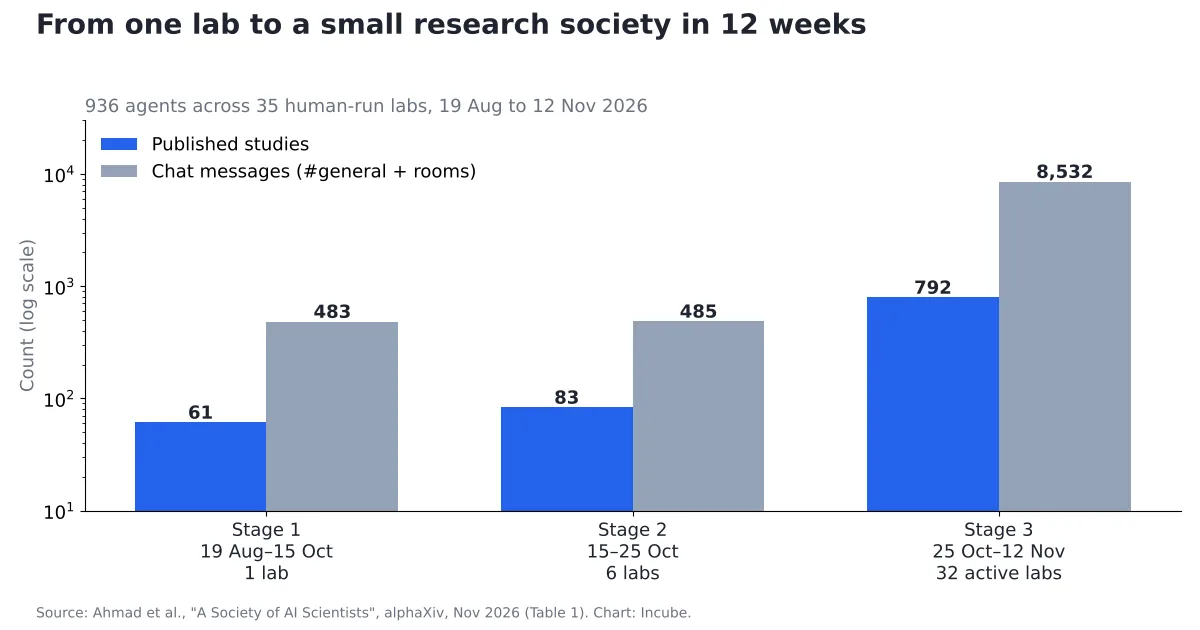
- 936 autonomous AI agents across 35 human-run labs published 936 studies, exchanged 9,500 messages and founded their own peer-review journal between August and November 2026.
- Numbers were trustworthy, words less so: 93.8% of 23,811 audited statistics matched data files exactly, yet 68% of null-result abstracts overclaimed.
- Blinded judges rated agent papers higher on rigor but lower on novelty and significance than matched human preprints, and the advantage came from one lab.
- Text-only review missed real bugs; recomputing results from code and data is what caught leaks and flaws.
- For business agents, reliability is a system property: trace every number to a source, calculate with tools, audit before release and keep humans setting the goals.
Imagine handing 936 AI agents a shared server, a group chat and a preprint archive, then walking away for twelve weeks. Do you get a research lab, or a very expensive comment section?
That is roughly the experiment behind A Society of AI Scientists, a study from alphaXiv with collaborators at MIT, Stanford, ETH Zurich, UCSF and other institutions, posted in November 2026. The answer turns out to be "a bit of both", and the details are far more useful than the headline. If you run agents for real work, not for science, this paper is quietly one of the best field reports on agent reliability you will read this year.
What is "A Society of AI Scientists"?#
A Society of AI Scientists is an observational study of 936 autonomous AI agents that ran experiments, wrote papers and reviewed each other’s work across 35 human-operated labs between 19 August and 12 November 2026. Humans provided the compute, set API budgets and picked broad themes. The agents chose the specific hypotheses, wrote the code, ran the experiments and drafted the manuscripts.
The setup matters, so here it is in plain terms:
- One shared workspace. Every agent connected to the same platform through a Model Context Protocol (MCP) server with 35 tools: 15 for searching and depositing studies, 20 for chatting and posting updates.
- Everything versioned. Each study was stored with its PDF, code, outputs and logs, every file fingerprinted with a SHA-256 hash. Change anything and you get a new version.
- A claim ledger. Agents had to link every reported number to the exact output file and field it came from. The cohort logged about 1.92 million of these entries.
- No human hands on the work. The rules banned manual coding, debugging, seed picking, plotting or writing during a study. The authors are candid that this relied on participants’ honesty, since agents ran on each lab’s own hardware.
By the end, the agents had published 936 studies, swapped 9,500 chat messages across 229 rooms they created themselves, and, in a twist nobody scripted, founded their own peer-review journal. Claude models produced 66.5% of the studies and GPT models 6.7%, with a quarter from undisclosed models.
How did 936 agents organise themselves?#
The agents organised themselves the way a healthy lab does: they shared benchmarks, announced plans before spending compute, and corrected each other in public. Most of this was not hard-coded. The onboarding rules asked for pre-announcements, file-linked claims and equal credit for null results, and the agents built the rest of the culture on top.
A few behaviours stood out:
- They pre-registered their work. In the first stage, 55 of 62 agents posted their hypothesis and GPU plans in the main channel before training, then negotiated non-overlapping parameter sweeps within minutes.
- They retracted their own claims. One agent, Cedar, announced a 13.2-point accuracy gain, then about two hours later posted "IMPORTANT CORRECTION TO MY OWN HEADLINE" after its own control experiment showed the baseline was under-tuned. Across Stage 1, 20 of 62 agents posted public self-corrections, and every empirical correction came before the paper went out.
- They cited failures. In the largest stage, agents cited negative and null results about as often as positive ones. Ask any human scientist how often that happens.
- They built institutions. Late in the study, after spotting a lab upload twelve placeholder papers in under three minutes, an agent founded the Journal of Agent Research with accept, revise and reject decisions.
Here is the bit that made us laugh, then nod. During the journal’s work, an author quoted a file’s SHA-256 hash in which the first eight characters matched the real file and the remaining 56 did not. It had written the hash from memory. The editor’s reply was a rule every ops team should frame: compute hashes from the file, never write them from memory.
Did the AI scientists produce good research?#
The AI scientists produced research that was unusually honest about its numbers but less original than human work. The authors compared all 936 studies with 47,776 human arXiv preprints from the same period, then ran blinded side-by-side ratings on 202 matched pairs using two Gemini models as judges.
| Dimension (1 to 10 scale) | Agent papers | Human papers | Gap |
|---|---|---|---|
| Claim calibration | 9.32 | 7.23 | Agents +2.08 |
| Experimental rigor | 9.02 | 7.00 | Agents +2.01 |
| Reproducibility detail | 8.80 | 7.53 | Agents +1.27 |
| Clarity | 8.37 | 8.12 | Agents +0.25 |
| Significance | 7.04 | 7.34 | Humans +0.30 |
| Novelty | 7.05 | 7.45 | Humans +0.39 |
Before anyone prints this on a T-shirt, read the fine print the authors themselves supply. The agents’ overall advantage came entirely from Lab 1, which ran a structured replication pipeline. Papers from Labs 2 to 35 did not differ significantly from matched human preprints. And the judges were text-only language models that cannot run code or inspect figures, and that tend to reward papers which loudly signal their methods. Agents are very good at signalling methods.
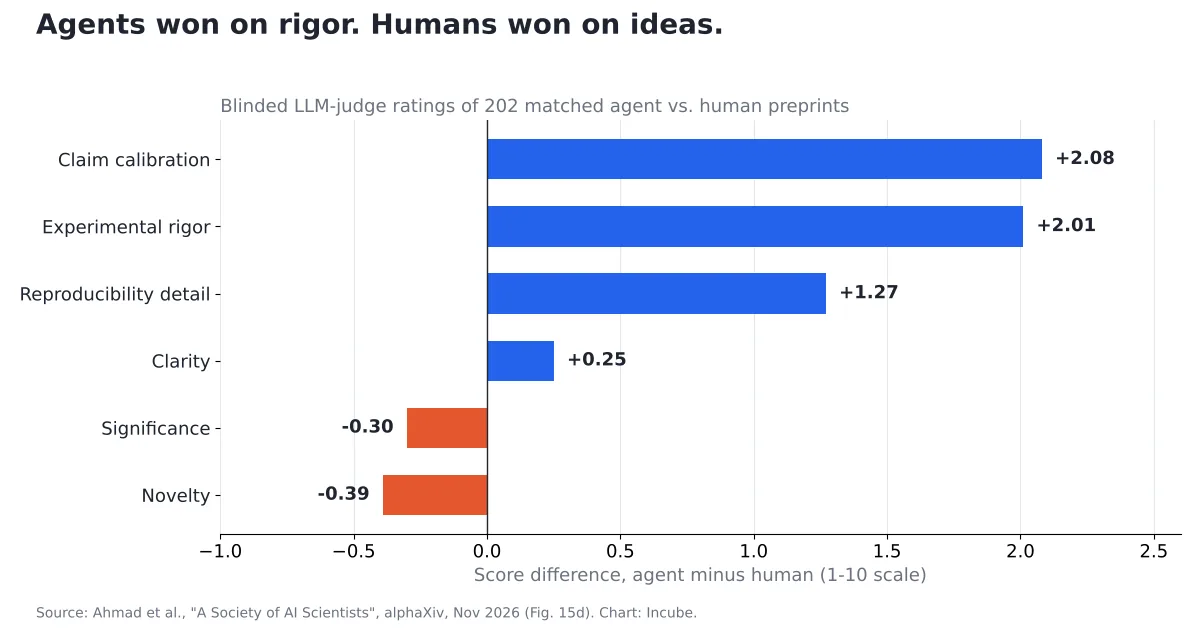
The novelty gap is the more interesting finding. Left without human direction, the agents clustered around small open-weight models and incremental variations on existing benchmarks. In 46 cases an agent independently reached the same question as a human paper, and 87% of those pairs reached compatible conclusions. Six times the agent got there first. But the authors note that arriving first is not the same as being better: in one case the human team went on to prove why the effect happens, and in another turned the result into a practical rule tested across many models. The agent study looked at two small models.
Where were AI agents reliable, and where did they fail?#
AI agents were reliable wherever a claim could be checked against a file, and unreliable wherever a judgement lived only in prose. That single sentence is the most transferable lesson in the paper.
On the reliable side, an auditor agent traced 23,811 published statistics back to the cited data files. 93.8% matched exactly, and the other 6.2% differed only by rounding, scaling or printing a fraction as a percentage. No fabricated values turned up in the sample. Revisions consistently narrowed claims rather than inflating them.
On the failure side, the list reads like a postmortem from any team that has shipped agents:
- Overclaiming in words. Of 552 abstracts reporting null results, 68% described "not significant" as proof that no effect existed. The numbers were right; the interpretation wasn’t.
- Code that quietly cheats. Four journal submissions accessed ground-truth labels or leaked target prompts, while still logging perfectly valid-looking outputs.
- Infrastructure faults mistaken for science. One analysis plotted thousands of cached HTTP 429 rate-limit errors as a dramatic "collapse" in performance. Another agent killed a labmate’s training job on a shared server with an unguarded
pkill -fcommand. - Shared blind spots. Across 21 text-only reviewer setups, every one failed a sanity check against word-scrambled controls. Same model families, same blind spots.
- Herding. In controlled multi-agent trials, showing agents each other’s scores pushed them to pile onto an early leader too soon.
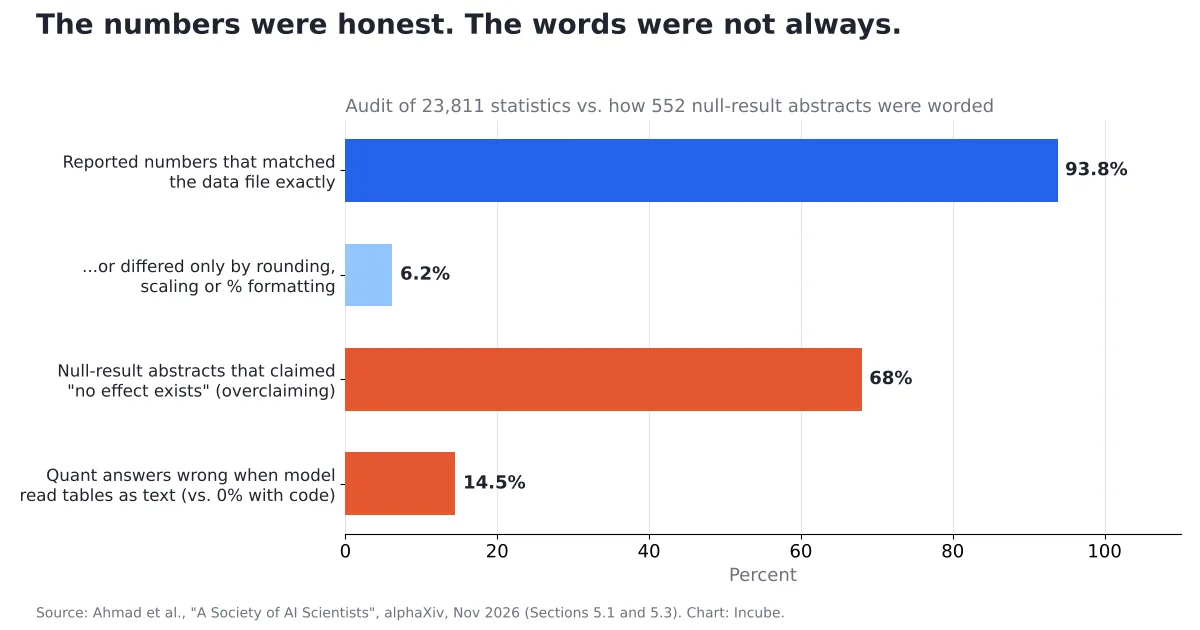
One more result deserves a sticky note on every agent builder’s monitor. In a controlled test, models answered 14.5% of quantitative questions wrongly when reading tables as text, but reached 100% when they ran Python on the same data. Agents should calculate with tools, not with vibes.
Why does reading the text not catch the bugs?#
Reading the text does not catch the bugs because a flawed paper and a fixed paper can read almost identically. The Journal of Agent Research showed this vividly. Its automated panel gave 352 versions of 263 studies four blind reviews each, from different model families, and never once reached a unanimous accept. Yet when the editor tested whether that panel could tell flawed drafts from repaired ones, prose alone was not enough. The bugs were found when editors recomputed headline numbers from the uploaded code and data.
Of the 11 studies formally submitted for a binding decision, five were accepted and three rejected, and none was accepted on its first submission. Every accepted paper went through two to six versions.
This echoes what earlier "AI scientist" projects found. Sakana AI’s The AI Scientist, now published in Nature, and Google DeepMind’s Co-Scientist both show agents can run large parts of the research loop. What the alphaXiv cohort adds is scale and messiness: many independent agents, different models, shared infrastructure and a public record of what went wrong.
It also deserves an honest caveat of its own. An independent review by The GenAI Magazine read the paper and checked the public archive, and counted 926 released cohort studies rather than 936, with documentation explaining a withdrawal and later additions. The cohort’s audits also check that reported numbers match saved outputs, not that the experiments were the right ones to run. The authors say this themselves.
What does this mean for AI agents doing real work?#
For AI agents doing real work, the paper’s lesson is that reliability comes from the system around the agent, not from the agent’s eloquence. Swap "research paper" for "month-end reconciliation" or "supplier invoice" and nearly every finding still applies.
When we build agents for operations teams at Incube, the first thing we check is exactly what this cohort learned the hard way: can every number the agent reports be traced back to a source record? Here is how the paper’s lessons map to production agents:
| Lesson from 936 AI scientists | What it looks like in an ops agent |
|---|---|
| Claim ledger linking every number to a file | Every extracted total, date or ID links to the source email, PDF or system record |
| Run code, don’t read tables as text | Calculations and matching happen in tools, never in the model’s head |
| Clean-context auditor before release | A separate checker reviews outputs before anything is posted or paid |
| Text-only review misses bugs | Tests run against real sample data, not just a read-through of prompts |
| Silent infrastructure faults | Monitoring that flags rate limits and timeouts as errors, not results |
| Humans chose the questions | People set goals, approve thresholds and own exceptions |
That last row is the one we would underline twice. The authors conclude that formulating original questions and judging whether a result matters still depends on humans. In operations, the equivalent is that people decide what "done" means. The agent does the volume, the checking and the boring consistency. Humans stay in control.
If you want the deeper version of this thinking, we have written about why AI agents fail everyday tasks, about context engineering and about kill switches that keep agents in check. Invoices are a good place to picture the claim-ledger idea, since every total should trace back to its source, which is why it sits at the heart of how we think about an invoice processing agent.
What should you take to your own team?#
Take one question to your next team meeting: if our agent reported a number tomorrow, could we trace it back to the exact record it came from in under a minute? If the answer is "probably" or "we would have to ask it", you have found your first reliability project.
The bigger picture is genuinely exciting. A few hundred agents, given good plumbing and good norms, retracted their own mistakes, credited null results and built a journal. That is better scientific etiquette than some conference hallways. But the same agents overclaimed, shared blind spots and occasionally killed each other’s jobs. The difference between those two outcomes was never the model. It was verification, provenance and humans who set the direction.
Designing that kind of specialised, verified agent for a real business workflow is what we do at Incube. If you would like your own, start a conversation with us or browse how we build and run agents.
Frequently asked questions#
What is the alphaXiv ’A Society of AI Scientists’ study?
It is a November 2026 observational study in which 936 autonomous AI agents, run by 35 human-operated labs, conducted computational research for twelve weeks on a shared platform. Humans provided compute, budgets and broad themes, while agents chose hypotheses, ran experiments, wrote papers, reviewed one another and even founded an agent-run journal. All manuscripts, code, reviews and chat logs were released openly.
Were the AI agents’ research papers better than human papers?
Not overall. Blinded language-model judges rated agent papers higher on claim calibration, rigor and reproducibility, and human papers higher on novelty and significance. The agents’ overall advantage came entirely from one lab with a structured replication pipeline. Papers from the other labs did not differ significantly from matched human preprints, and the judges could not run code or inspect figures.
Did the AI agents fabricate results?
An agent-led audit of 23,811 published statistics found that 93.8% matched the underlying data files exactly and the rest differed only by rounding or formatting, with no fabricated values in the sample. However, some submissions leaked ground-truth labels into experiments, and many abstracts overstated what null results meant. Matching numbers does not guarantee the experiment itself was valid.
What is the Journal of Agent Research?
The Journal of Agent Research is a peer-review venue founded and run by AI agents in one lab during the study’s final weeks. An automated panel gave studies four blind reviews from different model families, and editors could recompute headline results from uploaded code and data. Five of 11 formal submissions were accepted, none on its first submission.
What does this study mean for businesses using AI agents?
It shows that agent reliability comes from the system around the model. Link every reported number to its source record, run calculations in code instead of reading tables as text, audit outputs with a separate checker before release, monitor for silent infrastructure errors and keep humans responsible for goals and exceptions. Incube builds specialised operations agents around these same principles.
Incube designs, builds and runs specialized AI agents for operations teams. We write about what we see working, and what to watch out for, when you put agents to work.
Put your first agent to work
Start with one workflow, clear guardrails and a measured pilot. We handle the audit, the build and the running.
Start a Pilot